Patents & Technical Innovation
Gabus Frères filed a series of Swiss patents from 1912 through the mid-1970s — case construction, movement-retention systems, shaped cases, and bracelet fittings — direct evidence of the technical work behind the Gabus Frères / Usines Safir name, and one possible explanation for the firm’s work for demanding Swiss maisons. Three generations filed: founder Georges Gabus, his son Georges Gabus-Savoye, and — far more prolifically — his grandson Jean-Louis Gabus, credited with eight patents in all.
Patent Chronology
The patents do not establish Gabus Frères as a general engineering firm, but they show sustained, practical attention to case construction, the secure fitting of movements, and waterproofing — the last running from a 1932 winding crown through the crystal seal of 1963 and the sealed stem passage of 1966. A few filings range beyond the case itself: bracelet fixation and a clasp, a protective carrying container, a dial mechanism, and a tide-calculation bezel.
| Date | Number | Subject | Note |
|---|---|---|---|
| 1912 | CH62388A | Savonnette watch case | Filed by the founder himself at Le Locle — a removable ring inside the caseband carries the movement |
| 1927 | CH123970A | Cassolette watch case | Notched pendant seats flush against the bezel — a close-tolerance fit for the era's fashionable cassolette cases |
| 1928/29 | CH131399A | Cassolette watch case | A later cassolette construction related to the earlier filing |
| 1929 | CH140775A | Watch in a protective container | Filed as Gebrüder Gabus, the German form of the firm’s name; a spring lifts the case as the container opens |
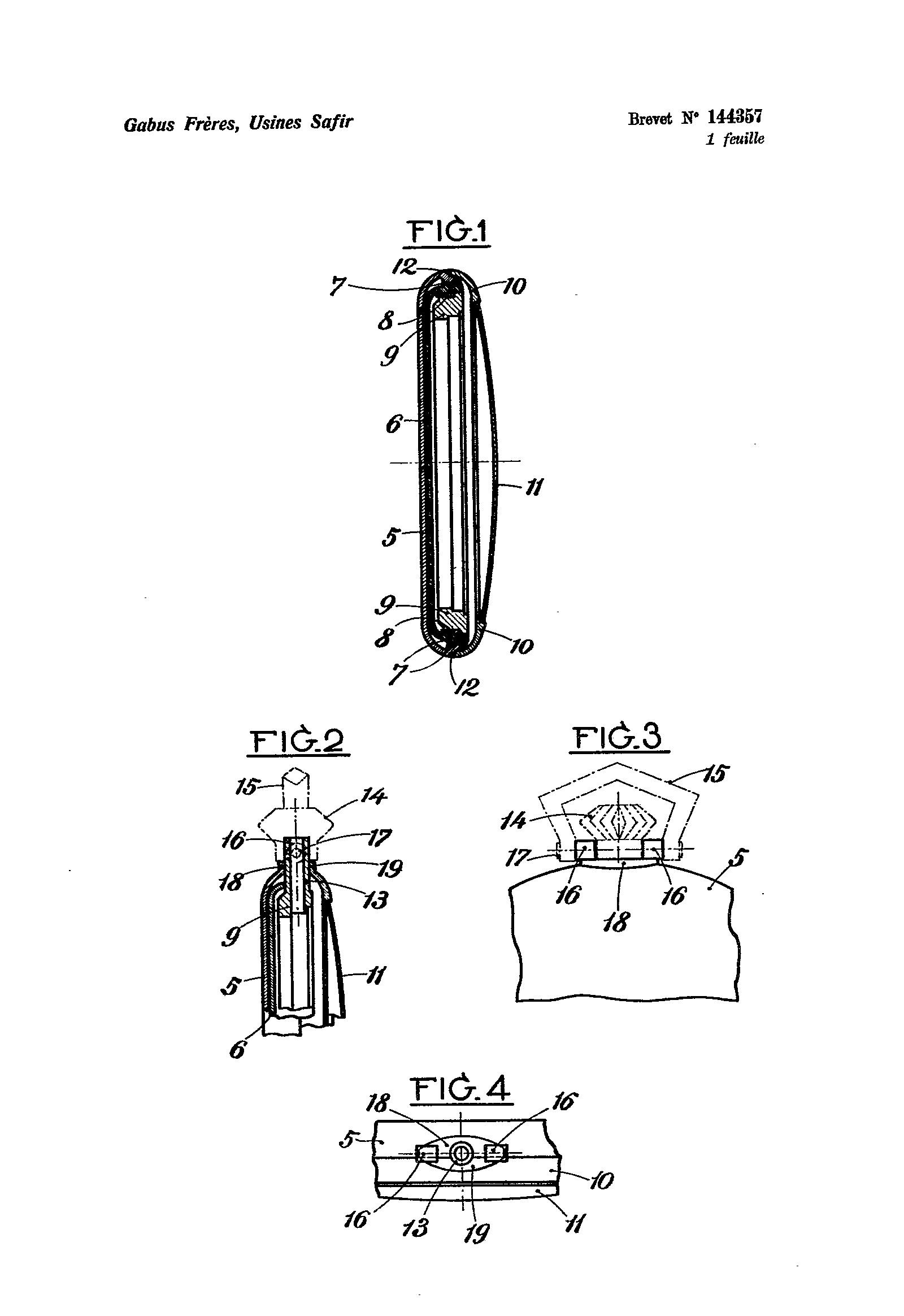
| 1930 | CH144357A | Watch case | Linked to Rolex Ref. 3068 |
| 1932 | CH162510A | Waterproof winding crown | Filed by the founder’s son, Georges Gabus-Savoye — a screw-down cap seals the crown against a compressible washer |
| 1946 | CH254855A | Watch case, dust-cover construction | Elastic dust-cover cup seals the caseback without adding case thickness |
| 1954 | CH317951A | Timepiece, casing-frame retention | Filed by the founder's grandson, Jean-Louis Gabus — the first of eight patents in his name — spring-retained casing frame; related movement-securing solutions appear in later patents, including CH356411A |
| 1955 | CH318512A | Wristwatch, bracelet fixation | Bracelet-lug ring bridging case and strap — bracelet engineering years before CH505585A |
| 1958 | CH348368A | Timepiece, rotating display disc | Rotating display disc under the crystal — a dial mechanism, not case construction |
| 1959/61 | CH356411A | Case / movement casing system | A conical bearing seats the frame under caseback pressure; four surviving examples are linked below |
| 1962/64 | CH385749A | Movement securing device with casing frame | Companion to CH356411A and CH427658A — movement retained via the casing frame alone |
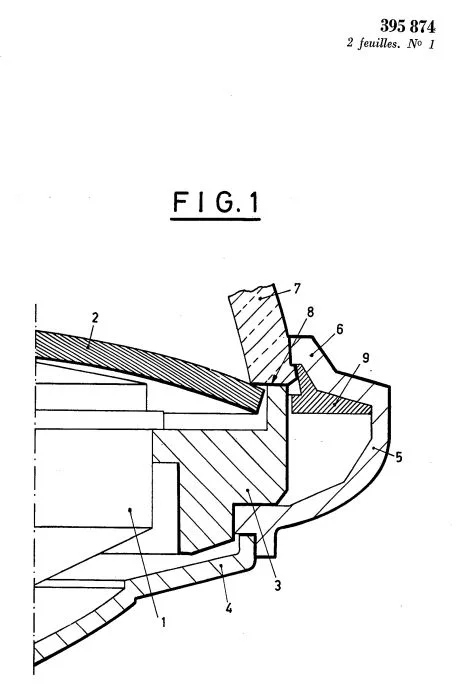
| 1963/65 | CH395874A | Waterproof watch case | Crystal sealed by a removable gasket rather than a re-machined notch — saves precious metal on gold and platinum cases |
| 1964/67 | CH427658A | Square-shaped watch case | Screws thread into a separate ring, not the case wall — keeps the square case's precious metal uncut |
| 1966/69 | CH470707A | Shaped watch case | Sealed winding-stem passage through the encasing frame — waterproofing without thickening the case walls |
| 1968/71 | CH505585A | Watch bracelet with clasp | Bracelet clasp — the firm's engineering reach extended past the case itself |
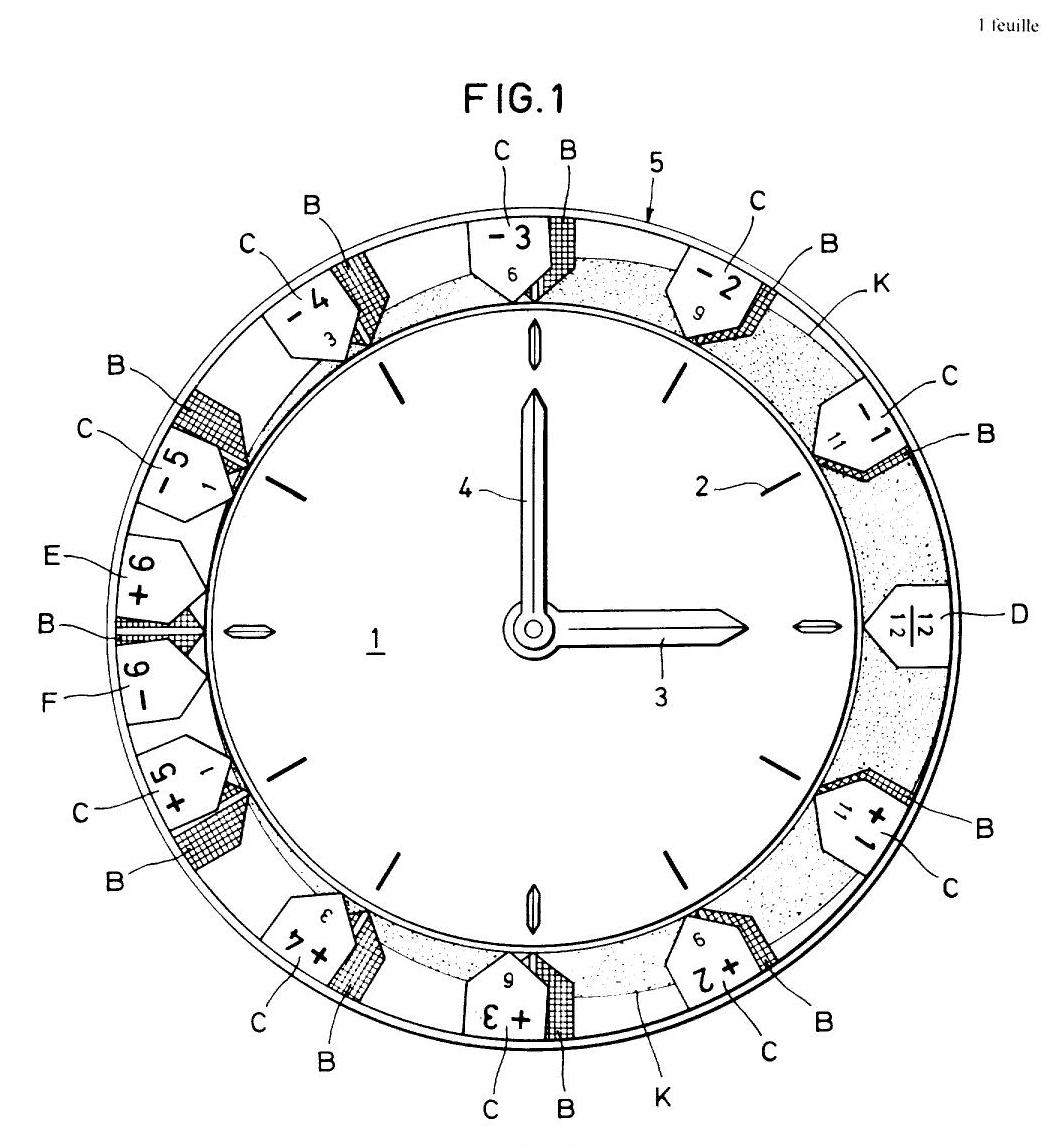
| 1972/76 | CH584930 | Tide-calculation bezel | A rotating bezel with two interleaved scales reads tide times off an ordinary movement — his only patent outside casework; see the case study below |
Key Constructions
Three of these patents are the work of one man: the founder's grandson, Jean-Louis Gabus. Over five years he developed the case/frame interface of CH356411A, the movement-retention ring of CH385749A, and the square-case screw-to-frame fixation of CH427658A — the last two filed through the firm.
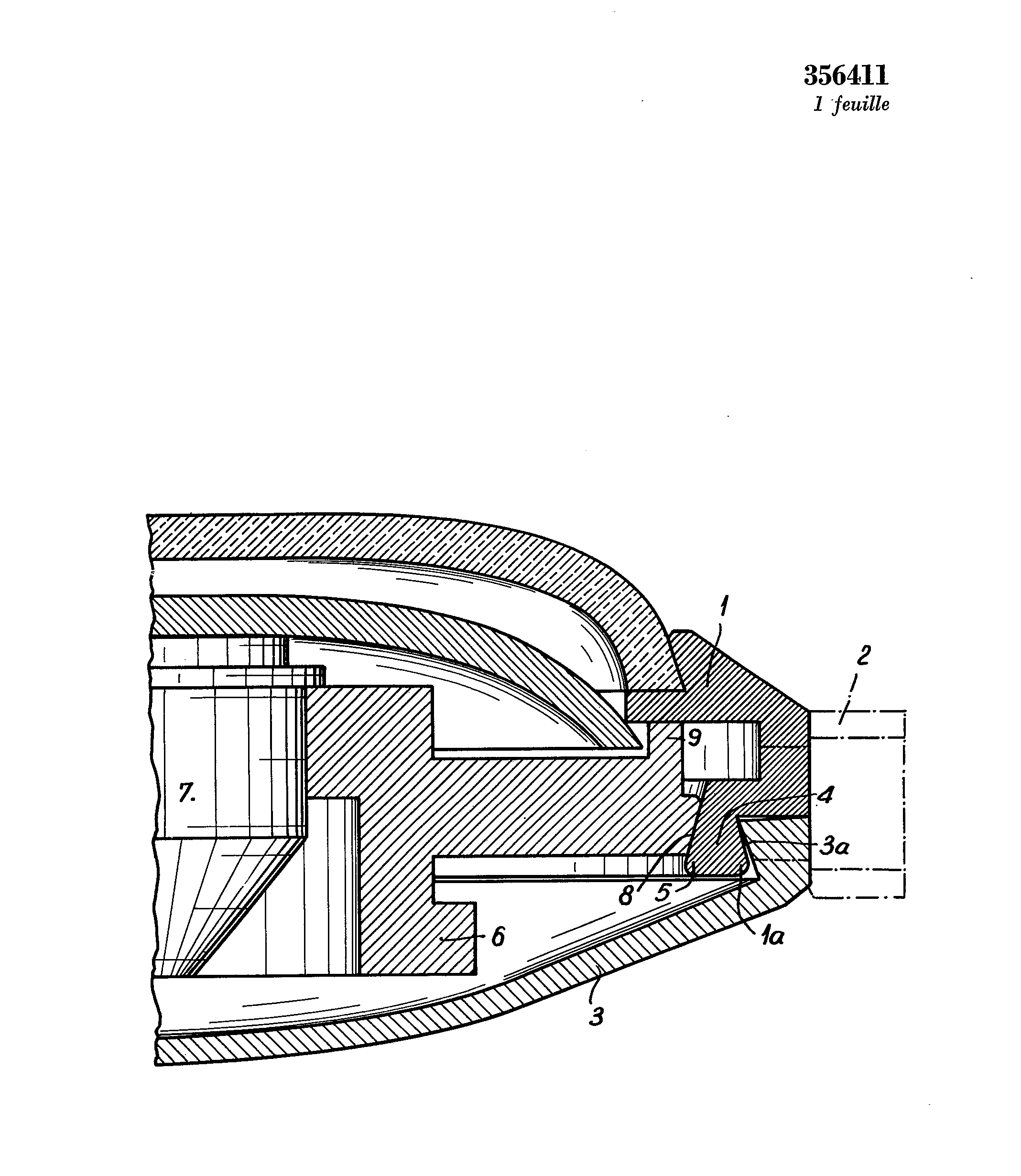
A conical bearing surface on the case mates with the casing frame; caseback pressure forces the frame against a stop inside the bezel. Four surviving examples document the construction, each showing the №141 mark beside brevet number 356411 — see the №141 register for individual case details.
This is a direct surviving pairing of a Gabus Frères patent number and the №141 mark documented in this archive. See the casebacks on the №141 register.
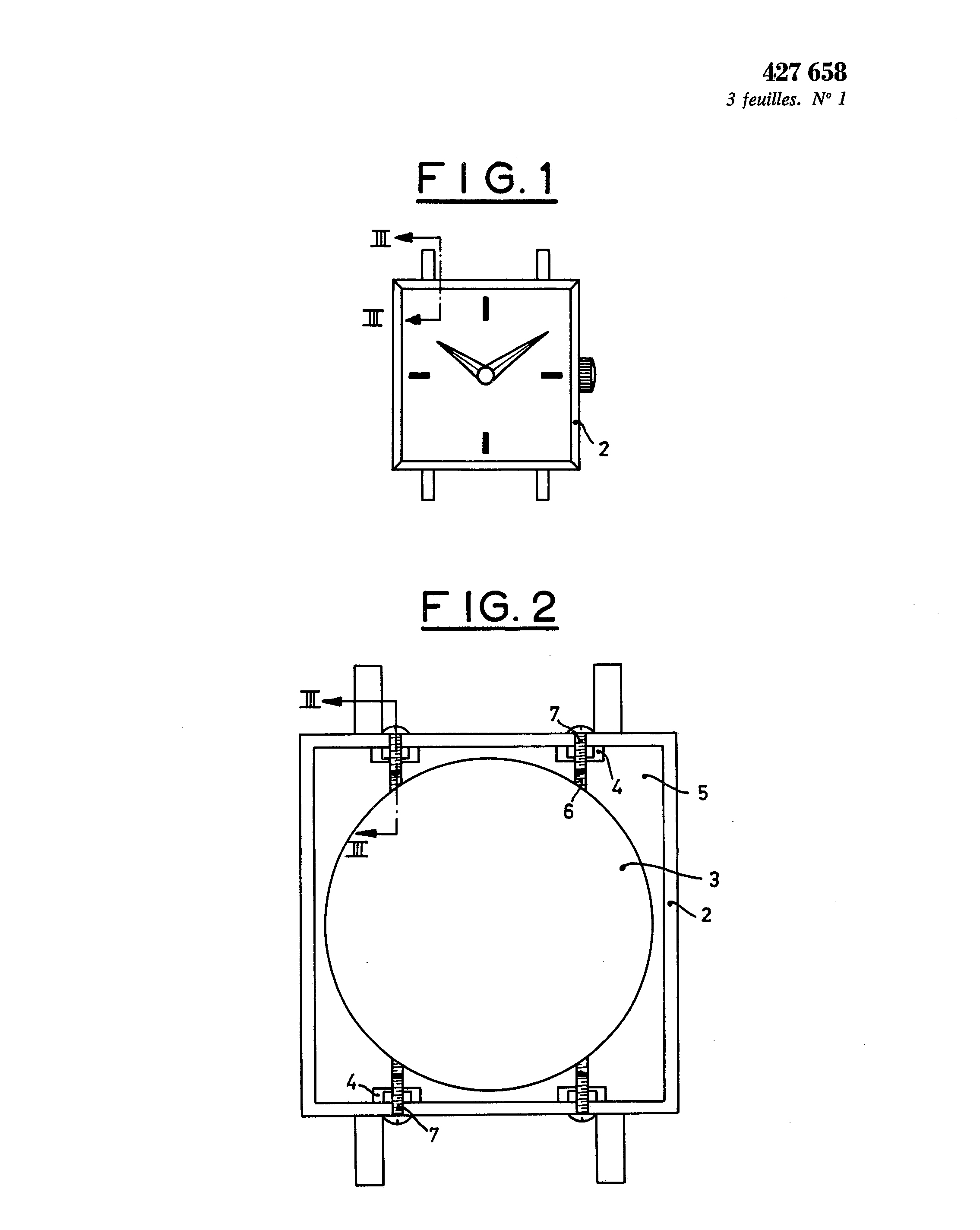
Screws pass through the thin case wall into threaded holes in a separate casing ring, never cutting threads into the precious metal itself — a construction especially suited to square and rectangular cases.
Together these three approaches form a coherent body of casework — one grandson's decade of practical solutions for integrating movements into thin high-end cases, with five more patents bearing his name elsewhere on this page.
Case Study: Swiss Patent CH584930 — A Tide-Calculation Mechanism
In 1972, Jean-Louis Gabus patented a way to read tide times off an ordinary watch. A rotating bezel carries two interleaved graduated scales — one for the coming high tide, one for low — spaced in units of 1h 2min 5sec, the offset between the lunar and solar day. Set once against a tide table, the bezel lets the wearer read the next high or low tide directly, without the dedicated tide-movement earlier patents (cited in the filing) had required.
It is his only patent outside case construction and waterproofing, and the only one filed through a different agent, Bovard & Cie of Bern, rather than his usual A. Bugnion. No surviving example has surfaced to date.
Case Study: Swiss Patent CH144357A and Rolex Ref. 3068
Surviving examples of Rolex Ref. 3068, a pocket watch produced in the late 1930s and early 1940s, carry the brevet number 144357 — French for “patent” — stamped inside the caseback. Auction documentation from Antiquorum (2019) states directly that the case is based on Swiss patent No. 144,357, associated there with Gabus Frères.
This remains one of the strongest single evidentiary links between Gabus Frères technical work and Rolex.
See this piece on the Collection page.
See also the documented auction appearances on the Sightings page.
Case Study: Swiss Patent CH395874A and the Baume & Mercier Baumatic
Jean-Louis Gabus's patent seals the crystal against a notch in the case band, its inner rim held under tension by the case's engaging ring, either directly or through a removable gasket fitted to that ring. The arrangement lets the crystal's edge overhang the case without machining a special notch — an advantage where extra material means wasted precious metal.
A surviving Baume & Mercier Baumatic carries the case stamp ‘BREV. 395874’ alongside the №141 mark — one of several surviving examples of a Gabus Frères patent number stamped directly into a case, each documented on the №141 register.
See this piece on the №141 register.
Why Gabus Frères?
No account has yet come to light explaining how or why Rolex, Vacheron Constantin, and the other maisons documented here first came to Gabus Frères rather than one of the more than one hundred registered Swiss case makers active in this period. What the patent record and trade documentation do show is a firm associated with technically demanding casework.
The filings cluster around a handful of recurring problems: ultra-thin construction associated with Vacheron Constantin, movement fixation developed through a sequence of patents, a square case associated with Rolex, and a waterproofing solution for precious-metal cases documented on a surviving Baume & Mercier caseback. The record also extends beyond case construction itself — bracelet fixation, dust-cover sealing, and other mechanisms recur across six decades of filings.
Case makers of this era typically worked either from a catalog of existing designs or against a brand’s stated technical requirement. Capability is one explanation for the atelier’s work across multiple Swiss maisons, and the names on the filings suggest where it sat: the founder, his son Georges Gabus-Savoye, his other son Jean Edouard — who led the firm as president from 1940 — and later Jean-Louis Gabus. In one case there was also a family tie — Gabus-Savoye’s wife was the daughter of Baptiste Savoye, director-general of Longines. Whether that bore on the casework is not documented. This remains an open question the evidence only partially answers.
Maker's Mark №141
The registration of Poinçon de Maître No. 141 to Gabus Frères of Le Locle on 21 July 1934 is confirmed by the federal register. The mark passed to the firm’s later forms — Usines Safir, and Oracier SA in 1974, a transfer recorded in the Schweizerisches Handelsamtsblatt. The number identifies the registered case maker, not the movement, dial, or hands. This archive’s hammerhead-flag icon is adapted from it.
Notes on Interpretation
- Confirmed patents are stated as fact.
- Links between patents and specific surviving watches are made only where documented, with the evidentiary basis stated at each link.
- No claim is made that Gabus Frères “invented” cases for any particular manufacturer beyond what the patent and auction records directly support.
- Later patents associated with a Georges A. Gabus (1980s, ETA-related) remain under separate investigation and are not connected here.
- Jean-Claude Gabus (1950–2003), Le Locle-born inventor of assistive-technology devices (“téléthèses”), is unrelated: his patents are not horological in nature, and no genealogical link to the three houses has been established.
- Three 1937 filings by a Georges Gabus-Vuille of Le Locle — a buffer gauge, its case, and a paper toilet-seat cover — are not the firm's; no link to the Gabus Frères line is established.
- Two Angélus electric-alarm patents (1962, 1965) name a Jean Gabus of Le Locle: Jean-Frédéric Gabus, Angélus's technical director from 1963, not Jean-Louis Gabus.
Five further filings, held by family members rather than the firm — CH29201A and CH32058A (Georges Quartier-Gabus), CH10709A (Pierre Brunner-Gabus), and CH48220A and CH49754A (Senn Brunner-Gabus) — are discussed on The Family page.
Sources
Sources: Swiss patent records and the Schweizerisches Handelsamtsblatt — primary; the Poinçon de Maître register via specialist reference; the Quartier-Gabus and Brunner-Gabus family ties via AEN civil registers, SHAB notices, and Geneanet family trees; Antiquorum auction documentation. Full sources