Gabus Frères, Usines Safir
Georges Gabus began making gold cases in Le Locle around 1881. Three generations later, Gabus Frères was making cases for watches with movements from Rolex, Vacheron Constantin, Jaeger-LeCoultre, and other Swiss maisons.
Origins
Georges Gabus (Georges Édouard Gabus, 1855–1915) was born at Le Locle into a family already in the trade. His father Édouard was a horloger, as were Édouard’s brothers Louis and Jules-Frédéric — three sons of Félix Henri Gabus, who had died in a fire in the town twenty years before Georges was born. Louis’s own sons founded the other two houses documented here, which makes Georges their first cousin. All three are named in the Le Locle registers as grandsons of Félix Henri and Émilie Dubois.
The firm’s own published history reaches back further, to Huguenot refugees who settled the Neuchâtel mountains for reasons of faith — a Claude Gabus recorded at Le Locle around 1520, his son Perrin received as a bourgeois of Valangin in 1563. A compiled chart at CEJARE gives the same root, though the two accounts may not be independent of one another. The near generations rest on the civil registers; the deeper descent does not.
In the early workshop, much of the work was done by hand, with simple tools and manually powered lathes. Around 1881 Georges began working on his own account at 13 rue de l’Industrie in Le Locle. Gold was melted in the kitchen; a “baron” rough-shaped it by hand; soldering was done over paraffin lamps; turning was done on lathes worked by a bow, one hand guiding the burin. It was a craft practiced piece by piece, before the firm’s later expansion into factory production. In the commercial register of 1883 Georges declared his trade simply as monteur de boîtes — gold case mounter. By 1934 the melting had its own federal registration: the precious-metals office published the punch the firm used to mark its melt products, a GF monogram in a rectangle, listed at 11a rue de la Concorde. That mark never went inside a watch — it identified the firm’s own cast stock.
Growth and War
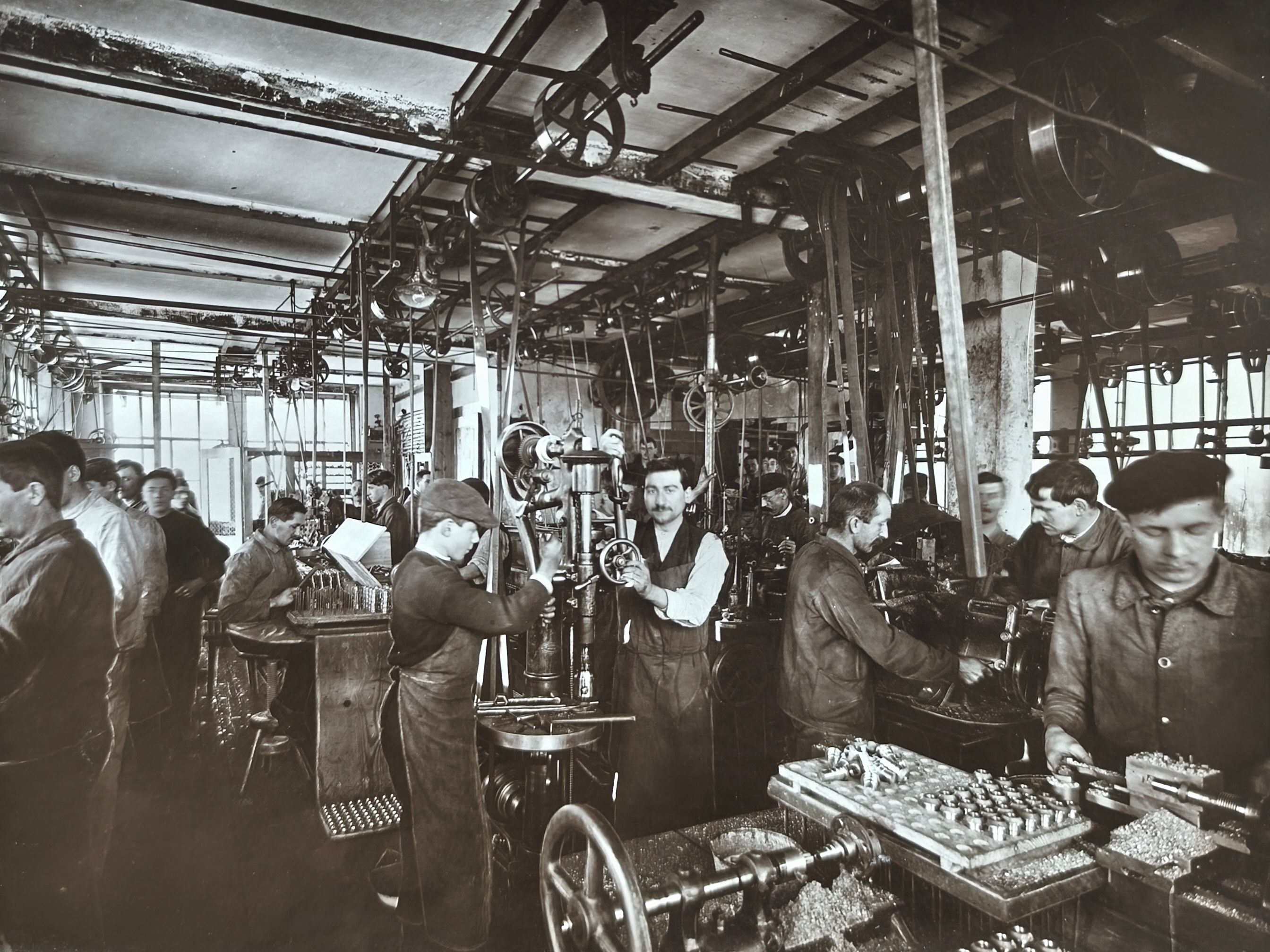
Around 1908 a new factory was built at Le Locle — No. 1, Chemin de la Combe-Sandoz, designed by the architects Oesch & Rossier, replacing an earlier workshop at Rue de l’Industrie 13 — with brighter, better-equipped space than the family had known before. Two of Georges’s sons, Georges Arnold (1882–1960) and Jean Edouard (1884–1964), formed a new partnership under the name Gabus Frères, commencing 1 January 1913 and registered that October at Concorde 11a. The entry records a change of trade as well as of hands: Georges had been a monteur de boîtes, a case fitter; his sons registered a fabrique de boîtes or et platine, taking over his assets and liabilities. He had given the business up rather than left it — his own name was struck ensuite de renonciation du titulaire. Georges stepped back into the work he loved best: making a small number of cases from start to finish, by hand, without a flaw, until his death in 1915. He was still filing patents in his own name — a savonnette case construction in 1912, three years before he died. A third brother, Raoul Edmond (1890–1957, d. Montreux VD), was a partner by the early 1920s and withdrew on 1 January 1923. The firm also operated a branch at La Chaux-de-Fonds, deregistered on 26 January 1923.
The First World War closed the firm’s ordinary trade. Gold was requisitioned by the National Bank and workers were mobilized or idled. Facing the same crisis as other Le Locle case makers, the firm’s directors turned to the French ministry of war and began producing artillery shell-fuse components on their existing machinery. The pivot was a common one in Le Locle: Gabus Frères was among a number of local firms — Nardin and Zenith included — that turned to munitions manufacturing for the belligerents during the war, and the profits it generated helped fund the industrial expansion of a new generation of local employers. In February 1917, the firm formally adopted the name it carried for the next half-century: Gabus Frères, Usines Safir — SAFIR standing for Suisse, Angleterre, France, Italie, Russie, the Allied powers of the war.
The firm returned to gold case-making at war's end considerably strengthened, and in 1918 its directors created a workers' relief fund, endowed with FS 10,000.
The Case-Making Craft
This is where Gabus Frères earned its reputation. The firm didn't compete on volume — it specialized in the technical problems that separated an ordinary case house from one the finest Swiss brands would trust with their most difficult designs: ultra-thin construction, snap-on and screw-down casebacks, fancy-lug work, and — later — square cases built to hold round movements. Its own period trade literature put the case maker's stake in the business plainly: "the case is to the watch what coachwork is to the automobile — often it's one that sells the other."
That inventive streak is documented across sixteen Swiss patents spanning more than five decades, from a 1912 savonnette case through a 1968 bracelet clasp — most of them case-construction work, the rest covering bracelet fixation, a protective carrying container, and a dial mechanism. The full patent chronology, with priority and publication dates and sketches, lives on the Patents page.
Fine Work & Good Reputation
At the firm’s jubilee on 19 October 1957, the founder’s son Georges Gabus-Savoye — Georges Arnold Gabus, using his wife’s maiden name — closed his toast to the workforce with a line the family still keeps:
“…vivre avec sécurité, c’est-à-dire avec joie et satisfaction, du produit de notre beau travail”
“…to live securely — that is, with joy and satisfaction — from the product of our fine work.”
-page-003.jpg)
“Tous les modèles et décors originaux de la maison sont déposés” — “All original models and designs of the House are registered.” A design/trademark registration notice, distinct from the firm's Swiss patents.
The Hammerhead №141
The federal register confirms the registration of Poinçon de Maître No. 141 to Gabus Frères of Le Locle on 21 July 1934. The register lists the firm under Usines Safir from 1940 and as Oracier SA from 1974 — still registered at Concorde 11a as of the early 1960s; by the end its address was Jaluse 6, Le Locle. The firm was incorporated into Holding Gramex in 1972 and ceased activity in 1979 following the holding company’s filing. The Poinçon de Maître No. 141 registration ended on 26 June 1980, and Gabus frères Oracier S.A. was formally dissolved on 3 June 1981.
Longines, and a Seat at the Table
On 19 July 1911 the Feuille d’avis de Neuchâtel recorded a marriage contract between Georges Gabus, gold case maker of Le Locle, and Andrée Savoye. He signed himself Georges Gabus-Savoye thereafter, in the local convention.
Her father was Baptiste Savoye (1851–1927), director-general of the Fabrique des Longines at Saint-Imier; her brother Maurice succeeded him and ran the firm until 1965. Mémoires d’Ici, the archive of the Bernese Jura, catalogues Andrée Savoye (1889–1978) as Andrée Gabus and records her sister Angèle as Baptiste’s daughter. A 1925 family notice for their mother lists “Madame et Monsieur Georges Gabus-Savoye et leurs enfants, au Locle” among the household at Mont-Soleil.
This is the only documented personal connection between a Gabus house and any maison on the №141 register. Longines watches in Gabus Frères cases are recorded there. Whether the marriage bore on that work is not documented.
Two Brothers, One Trade
Georges Arnold’s institutional life reached well beyond his own firm. From 1936 he sat for over twenty years on the boards of two organisations that shaped the industry from outside any single company: the Société d’apprêtage d’or, which prepared the gold the case trade worked in, and ASUAG, the holding company created in 1931 to reorganise Swiss watchmaking as a whole. In 1957 he was also named to the board of the Banque cantonale neuchâteloise. On the same ASUAG board, for eighteen of those years, sat his brother-in-law Maurice Savoye — who ran Longines throughout that period and sat on the Swiss National Bank’s council besides.
His brother Jean Edouard’s path ran alongside. In February 1917 the two men formed a limited partnership at Cernier for precision mechanics and chronometry, and three months later, with the spring-maker Emile Schweingruber of Wahlern, founded Ressorts Safir at Saint-Imier — a springs manufacturer, excluded by its own charter from watch springs and hairsprings, that failed within four years and was declared bankrupt in March 1921. In 1940, when the original 1913 partnership was dissolved and reformed as Gabus Frères, Usines Safir S.A., Jean Edouard became its first president. By 1953 he headed the Fédération Suisse des Associations de Fabricants de Boîtes de Montres en Or — the national federation representing Swiss gold-case manufacturers. The connection predates his presidency: in June 1934 the Fédération gave its own address as 11a rue de la Concorde, Le Locle — the Gabus Frères premises — having been seated at La Chaux-de-Fonds as late as October 1932.
For a decade or more, then, one firm’s name never appeared on a single dial, while its two directors sat at the same time on the board that governed the industry’s cartel structure, the company that prepared its gold, the bank that financed it, and the national association that spoke for its case-makers — with a marriage reaching, besides, into the family that ran one of the firm’s client maisons. A case-maker’s mark does not appear on a dial; the men who held it were not therefore obscure.
The Third Generation
The third generation is documented in two men. Michel Paul Gabus (1916–1985), son of Georges Arnold, is recorded as a gold case maker. His cousin Jean-Louis, born at Le Locle in June 1913 to Jean Edouard and Jeanne-Ida née Gabus — daughter of Georges-John Gabus of Gabus-Guinand — was the firm's most prolific inventor — named on patents from 1954 to 1976 covering casing-frame retention, bracelet construction and the waterproof case of CH395874 — and wrote Origine et Histoire du Fonds Gabus Frères in 1989.
Case to a Reputation
The hammerhead №141 is normally found on the case rather than on the visible face of the watch.
Across the later decades of the firm’s history, Gabus Frères cases turned up inside pieces from major Swiss houses, among them — with evidence tiers varying by attribution:
- Rolex
- Vacheron Constantin
- Jaeger-LeCoultre
- Breitling
- Omega
- Universal Genève
- Longines
- Blancpain / Rayville
- Zenith
- Gruen
- Lucien Piccard
- Baume & Mercier
Open Questions
- The 1989 company history records that Gabus Frères was incorporated into the Holding Gramex in 1972; how that incorporation related to the firm's separate renaming to Oracier SA in 1974 is not yet established.
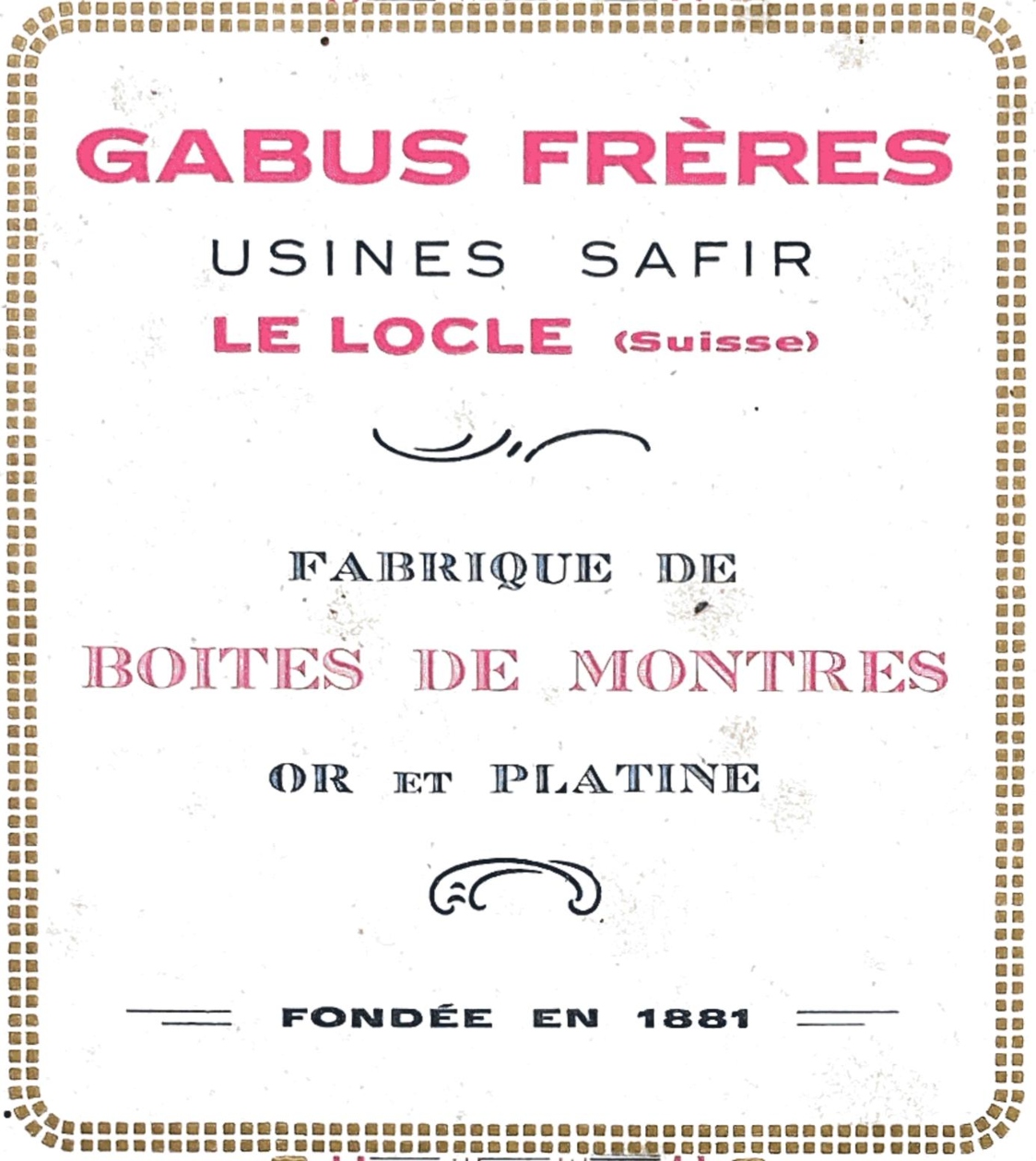
- The firm’s brochure and letterhead give 1881 as its founding, but the jubilee of 19 October 1957 was presented as its seventy-fifth anniversary, implying 1882.
Cross-References
The Hammerhead №141's full roster of documented client houses, tiered by evidence strength, lives on the №141 page. The firm's full patent chronology is on the Patents page.
The Le Locle registers name Georges Gabus as a first cousin of Louis William Gabus and Georges-John Gabus, founders of W. Gabus and Gabus-Guinand — see the The Family page for the full family connection.
Sources
Sources: CEJARE, fonds Gabus Frères; Swiss federal patent records; the Schweizerisches Handelsamtsblatt (SHAB); Mémoires d’Ici, fonds Madelaine Butticaz; the Neuchâtel digitised press; and INSA, Inventaire suisse d’architecture — primary. The No. 141 registration, its 1940 and 1974 name changes and its 1980 cancellation are recorded in the SHAB; the mark’s own history is supplemented by specialist reference. Board mandates via Obélis (Université de Lausanne). Published references: Fabricants et horlogers loclois (Répertoire), Johann Boillat (2016, 2019), and Pierre-Yves Donzé. Full sources