Gabus-Guinand
A watch house on the Grande Rue at Les Brenets, a small watchmaking village on the French border a few kilometres from Le Locle. Georges-John Gabus set up here in the 1880s, more than a century after his family left the village — and gave the firm a name that joined two households who had lived alongside one another here since at least 1714. The firm was built almost entirely around the Russian trade, its last trademark registered in Cyrillic. The October 1917 Revolution abruptly closed the market and left money owed across the border.
The House at Les Brenets
The house operated from an atelier on the Grande Rue in Les Brenets, under Georges-John Gabus, who registered its marks as John Gabus-Guinand. Its storefront carried Cyrillic signage addressed to its Russian clientele, advertising direct trade with Russia, while any commercial relationship with the Moscow house of W. Gabus remains unestablished.
The firm’s own record reaches back further than its trademarks: a power of attorney filed at Les Brenets on 15 March 1883 is the earliest surviving trace of “Gabus Guinand” in the commercial gazette, four years before its first trademark filing. By 1900 a contemporary account described it as «une maison d’horlogerie florissante» — a flourishing watchmaking house. By 1906 Georges-John had built a villa on the edge of the village and moved his atelier there.
The firm was still listed as an active exporter in 1907, and in January 1908 it renewed its 1895 mark — this time styling itself fabricant et négociant, manufacturer and merchant, a description it had not used before. A separate 1908 entry suggests a further renewal, but it survives only as a partial quotation and the register act behind it has not been found.
In 1915 the firm took out a fully paid 10,000-franc insurance policy — evidence of activity right up to the eve of the Revolution. Two of its 1895 marks, Nos. 7927 and 7928, were struck from the Swiss register in June 1916 for non-renewal, per the SHAB cancellation notice read directly as page images (Band 34, p. 1111); a third, No. 7926, it had renewed in January 1908. The 1917 Russian Revolution ended the arrangement that had sustained the firm for three decades: a local history of Les Brenets records that Gabus-Guinand “subit de grosses pertes” — suffered major losses — unable to recover money tied up across the now-closed Russian border. Georges-John died that same October, though no source connects his death directly to the crisis. The firm did not close immediately; it was still listed as an active manufacturer in Les Brenets as late as 1923, though that listing does not establish who was operating it. No later trace of it has yet been found.
Four original filing groups, dated 1887–1897, covered nine distinct marks:
- 28 October 1887 — No. 2078 — “G. G.” / Marque de la Maison (with cannon device) — registered to John Gabus-Guinand
- 19–20 December 1892 — four separate registrations (Nos. 6180–6183), covering the “Aiguilles ⊙ 15 Rubis” script mark, the “Remontoir / Rubis” mark, a cannon-in-belt device, and the “Gabus-Guinand, Brenets” two-riders device — registered to J. Gabus-Guinand
- 6 December 1895 — Nos. 7926, 7927 and 7928, the Brenets banner mark, a scrolled cartouche variant, and the “G. G. Brenets” mark
- 29 December 1897 — “Imperial / 15 kamney” (in Cyrillic) — registered to John Gabus-Guinand
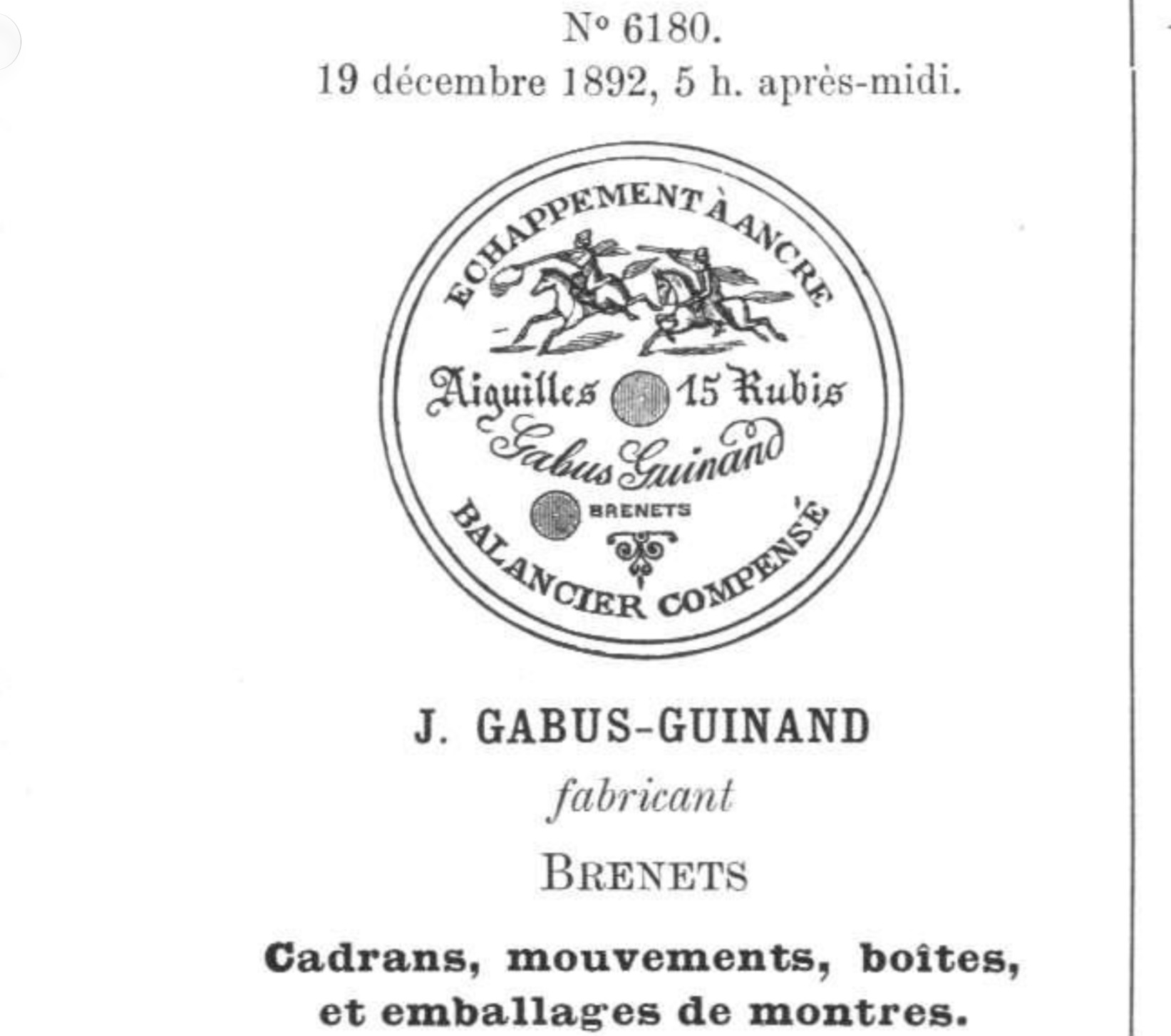
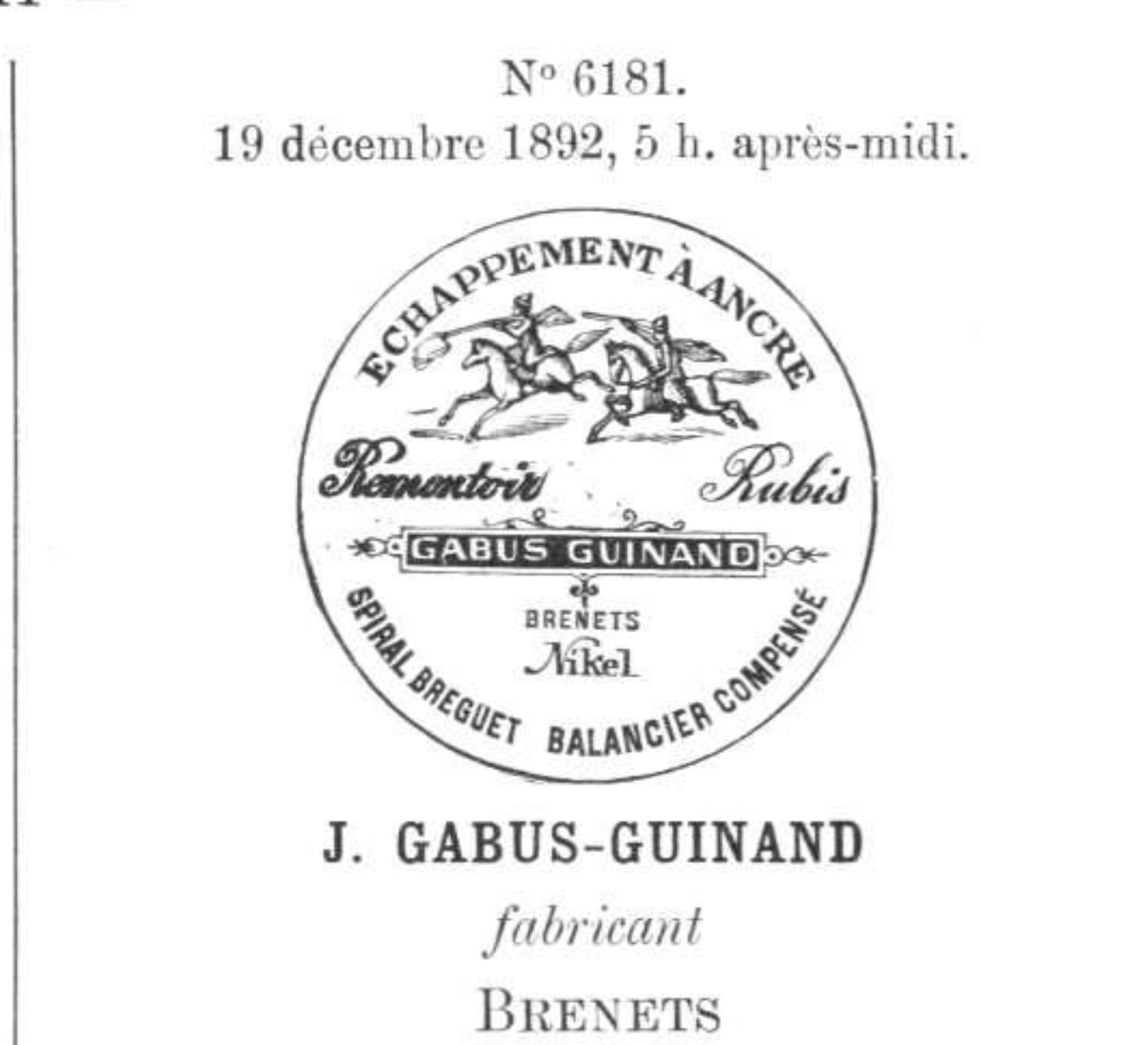
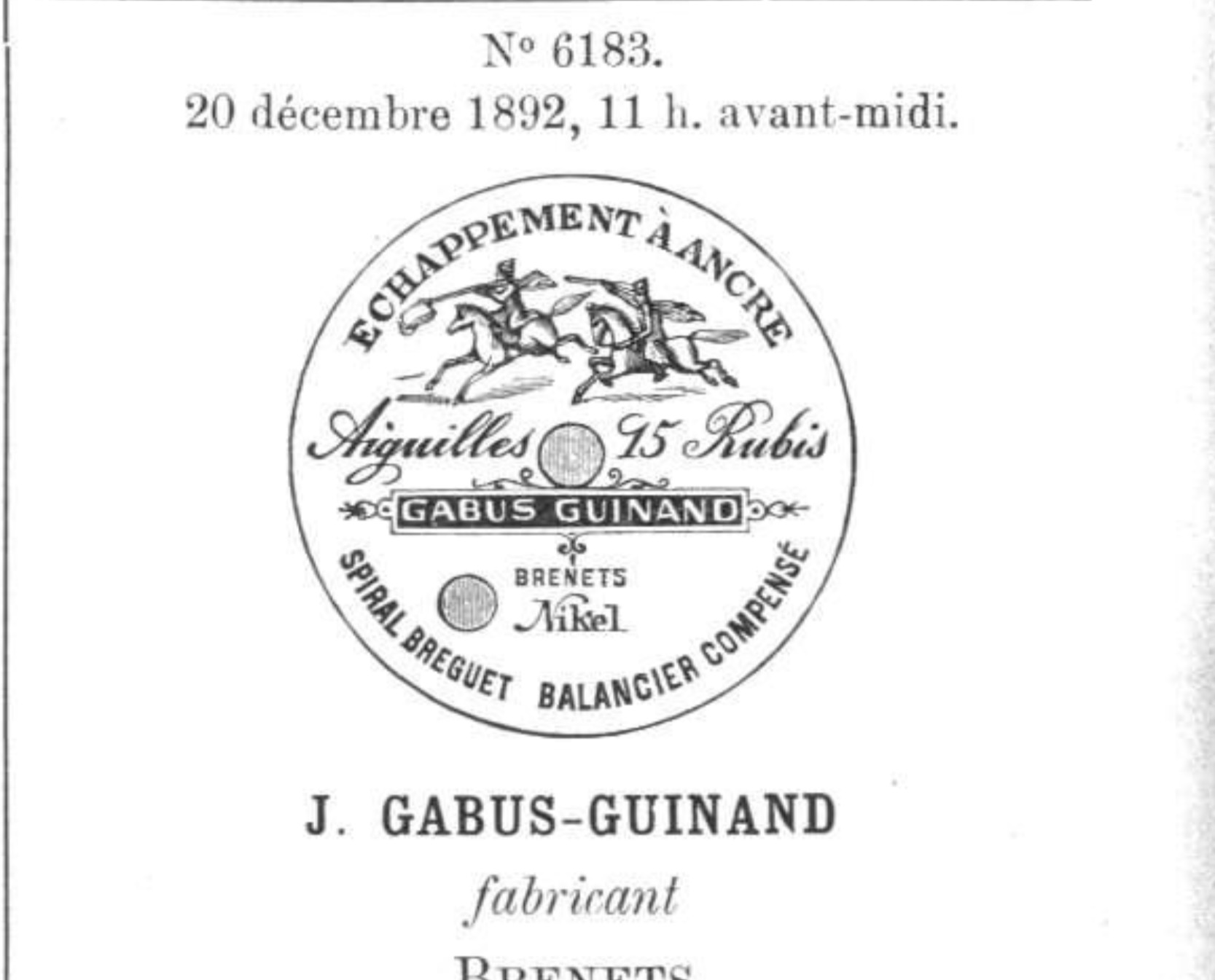
The registrations describe distinct devices and movement grades rather than a single static mark: the 1887 filing paired “G.G.” with a cannon on cuvettes, backs, and dials; the 1892 filings included two separate “two knights on horseback” registrations — “Gabus-Guinand, Brenets. Échappement à ancre, aiguilles, 15 rubis, balancier compensé” and a fuller variant specifying “Échappements à ancre, remontoir, rubis, nickel, spiral Breguet, balancier compensé” — alongside a “spiral Breguet” variant and “Gabus-Guinand, Brenets (Suisse)” with a cannon in a belt; and three further filings in 1895, Nos. 7926–7928, registered for watch dials and cuvettes, though which device belongs to which number is not established in the sources cited here.Marks page
Together these four filing groups span a full decade, from the 1887 mark through a 1897 registration made explicitly in Cyrillic and calibrated to the Russian market — "15 kamney" being Russian for 15 jewels, a movement grade stated directly in the trademark itself.
Of the four marks registered in December 1892, three — Nos. 6180, 6181 and 6183 — cover cases, dials and movements together; No. 6182 covers dials, movements and packaging, without cases. The firm's other five marks, of 1887, 1895 and 1897, cover cuvettes, case backs and dials only. Trademark scope records what a house claimed the right to mark, not what it made. No document has been located showing where Gabus-Guinand’s watches were manufactured. What the record does show is a house that marked and sold complete watches under its own name, with the Russian trade present from the first filings onward.
What Survives
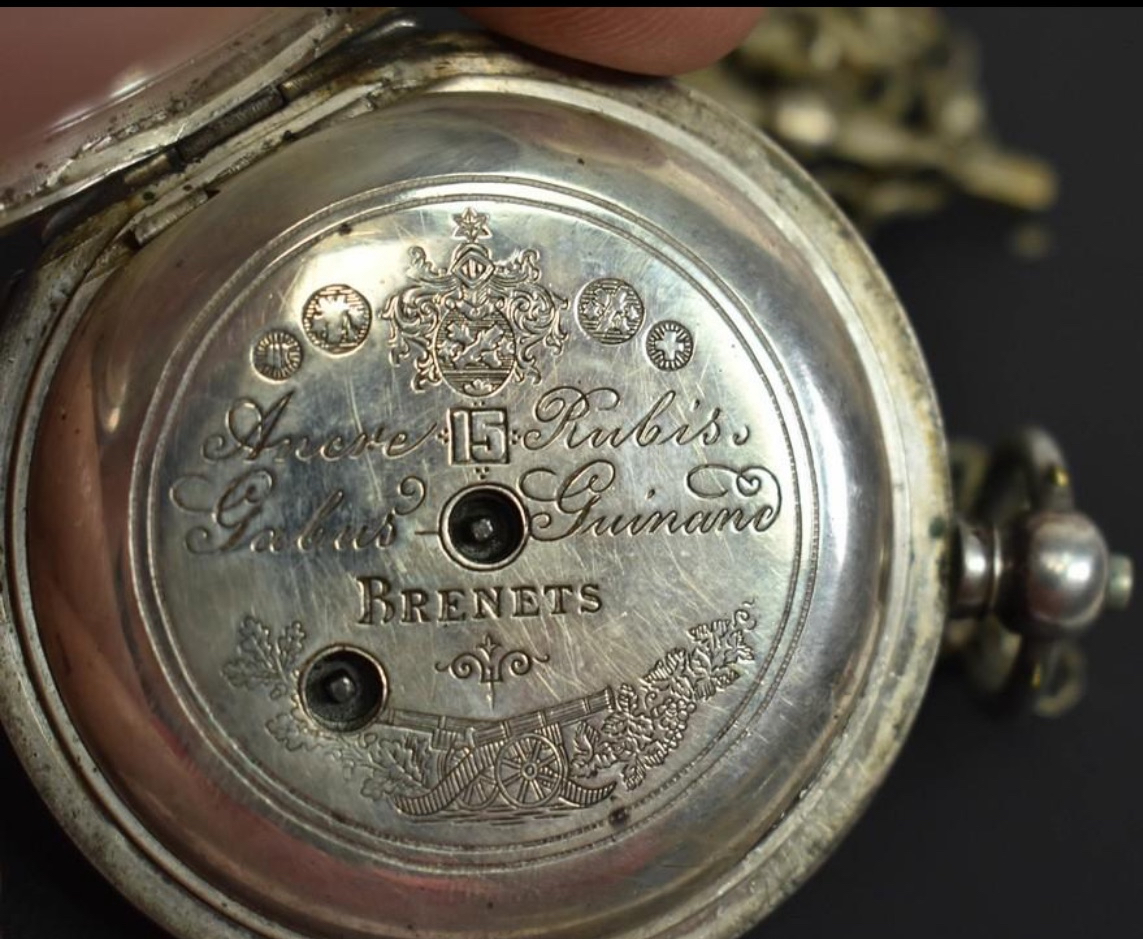
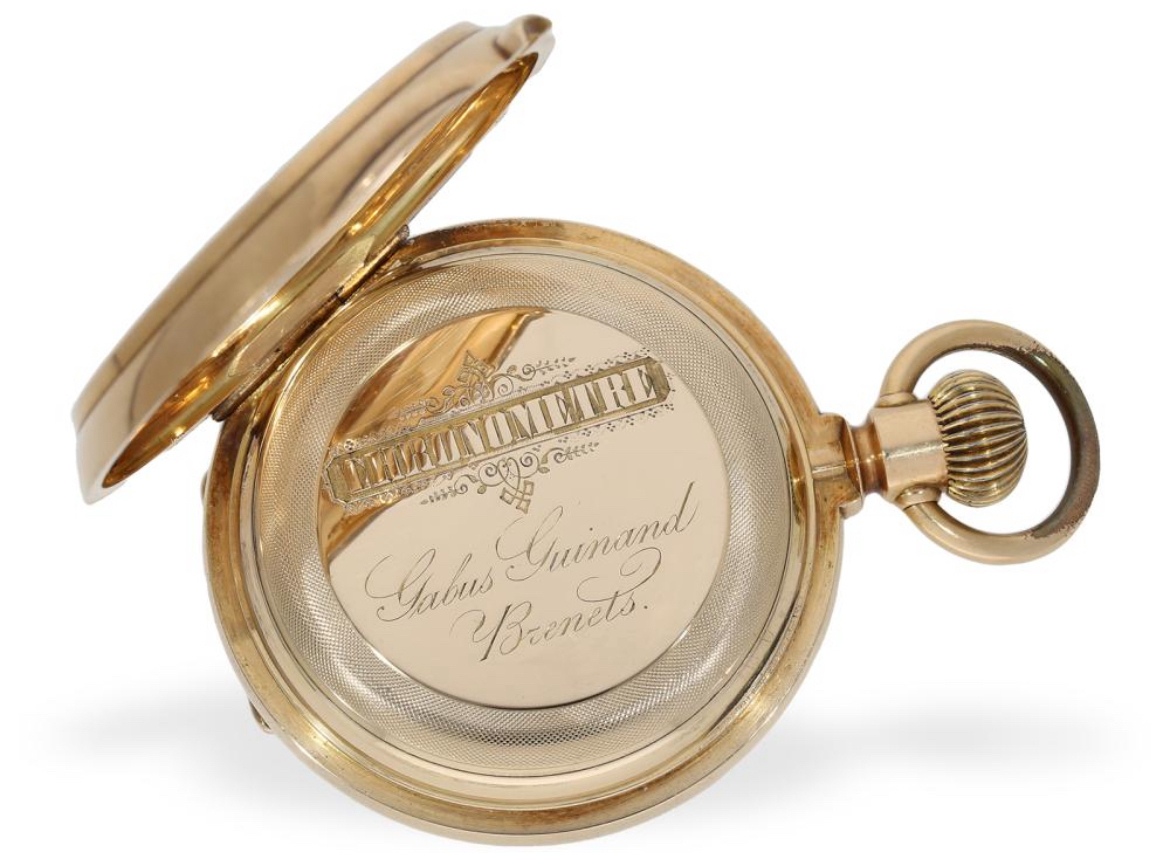
Several documented pieces anchor the surviving record, and they do not describe one kind of watch. At the top are gold complications — a quarter-repeater and a pivoted-detent chronometer, both circa 1890, both attributed to the Grande Rue atelier by name in their own auction descriptions. Below them sit plain silver watches in the Russian standard, and a monogrammed hunter whose cuvette prints the firm’s specification in full, close to the language of the 1892 registrations.
One surviving silver watch makes the Russian-market connection more explicit. It is engraved «ЗА ОТЛИЧНУЮ СТРЁЛЬБУ» — “For Excellent Marksmanship,” crossed rifles over a target — made to the pattern awarded for shooting proficiency in the Imperial Russian army. These were a standing catalogue category rather than one-off commissions: the 1918 catalogue of Pavel Buhré, the largest Swiss house in the Russian market, gives them a page of their own at eighteen roubles in silver.
Gabus-Guinand’s market ran through Russia by several channels at once, and reached more than one class of customer — the storefront signage and the 1897 Cyrillic trademark point the same way.
A Family Already Entwined
The Gabus and Guinand families of Les Brenets were bound together long before any watch bore both names. In 1714 the parish greffier Daniel Guinand stood godfather to a Gabus child; on 4 March 1733 his son Pierre married that child’s sister, Anne Marguerite, daughter of Jacob Gabus. A generation later the alliance reversed: on 15 July 1750 Anne Marie Guinand, daughter of the judge Abram Guinand, married David Gabus — and when their son Pierre Frédéric was baptised at Les Brenets in 1756, both godparents were Guinands, one of them described as a nephew of the father. Georges-John’s marriage to Amélie Guinand, more than a century later, was the latest turn in a much older connection.
One child of the first marriage, Pierre-Louis Guinand, trained as a watchmaker before turning to a harder problem — casting optical glass without flaws — and solved it; the technique, later called guinandage, became the standard for lens-making across Europe. The marriage that gave this house its name follows a century later: Georges-John Gabus — paternal half-brother of the Moscow retailer Louis William Gabus — married Amélie Guinand, some years before Gabus-Guinand’s own trademarks were first registered. She outlived him by three years, dying in Maisons-Laffitte, near Paris, in 1920.
No direct commercial link between Gabus-Guinand and Gabus Frères of Le Locle has been established, though the two houses were linked twice by family — their founders were first cousins, and a generation later Georges Gabus’s son Jean Edouard married Georges-John’s daughter, Jeanne-Ida, in 1912. The tie to W. Gabus is closer still: Georges-John was Louis William’s paternal half-brother. From the late 1880s the Les Brenets house registered its trademarks under the name John Gabus-Guinand — Georges-John trading under his second given name, confirmed directly by the firm’s own 1894 commercial-registry filing. His own brother, Alexandre Henri Gabus, traded as Gabus-Calame — the CEJARE tableaus record his marriage to Marie Sophie Calame, the maiden name the firm used. Gabus-Calame operated from rue de France 1, c. 1895–1916.
Georges-John and Amélie’s daughter, Edith Amélie Gabus, born at Les Brenets in 1879, married Georges Brutus Quartier-la-Tente there on 6 August 1900 — a Les Brenets name already established through the Quartier-la-Tente line recorded in the parish registers a century and a half earlier. He filed two Swiss patents for Roskopf movement work from Les Brenets in 1904 and 1905, four years into the marriage, and appears to have run his own family’s manufacturing house, Emile Quartier & fils, active from at least 1887; by 1906 he sat on the founding committee of a Jura watch-industry employers’ association representing that firm. No connection to Gabus-Guinand has been found.
Pierre-Louis Guinand & Optical Glass
Pierre-Louis Guinand solved a problem that had defeated glassmakers for decades: casting large optical glass without internal flaws. His technique let opticians build telescopes powerful enough for serious astronomical work — and he taught it personally to a young Joseph von Fraunhofer, who later discovered the dark lines in the solar spectrum that founded the science of spectroscopy. The method endured long enough that the Corning Museum of Glass still catalogs “a Guinand” as the standard term for his fireclay stirring-pot.
Open Questions
The firm's business history is reasonably well documented — but real gaps remain:
- The exact date the firm closed or deregistered is not yet established — it was still listed as active in 1923, though who was operating it by then is not established, and no later trace has surfaced in trade directories or trademark records through the 1930s–40s.
- No confirmed commercial link to Gabus Frères — though the two houses' founders were first cousins, and a generation later intermarried (see Cross-References)
- How the Grande Rue atelier's Russian trade related, if at all, to W. Gabus in Moscow remains unknown. The Swiss records searched so far contain no trace of the Moscow house, which may reflect the difference between a Russian merchant house and a Swiss-registered workshop rather than evidence that no connection existed.
Cross-References
The pieces discussed above also appear as Reference Examples on the Collection page.
Georges-John Gabus is documented on the W. Gabus page has been proposed, but not confirmed, as the “Jean Gabus” of the Varentsov memoir's Bukhara story. His first cousin, Georges Gabus, founded Gabus Frères — see the The Family page for the full family connection.
Sources
Sources: CEJARE, fonds Gabus Frères; FamilySearch parish and civil records; and Swiss commercial registers. Published reference: Pritchard, Swiss Timepiece Makers. The Edith Gabus–Quartier-la-Tente marriage is recorded on the Cimetière communal des Brenets headstone and corroborated by four independent Geneanet family trees. Georges Quartier-la-Tente’s business and industry-association activity is documented in the Schweizerisches Handelsamtsblatt (FOSC), via e-periodica.ch. The registration images above are reproduced via Mikrolisk. Full sources