W. Gabus / В. ГАБЮ
A Moscow retail and atelier house, trading as В. ГАБЮ and W. Gabus — window displays lit by bulbs against red and black velvet, institutional customers from officers' societies to consumer cooperatives, and a founder who sold Patek Philippe alongside his own stock.
From Le Locle to Moscow
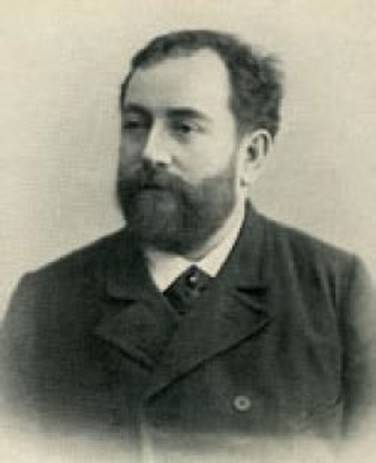
Louis William Gabus left Le Locle for Moscow in 1868, founding his firm there at twenty-one. His father, Louis Gabus, was himself a Le Locle watchmaker, recorded as horloger in the civil register by 1854.
Operating for nearly half a century, the house combined retail, repair, and an attached workshop under the names “В. Габю” and “W. Gabus,” serving both private customers and institutions across Moscow. William died in 1901, and the firm continued at Nikolskaya 15 through the 1917 Revolution. The house disappears from the record during the nationalisation of Russian watchmaking that followed the Revolution; no firm-specific record of its closure or confiscation has been located.
Primary Source — The c. 1890s Price Catalog
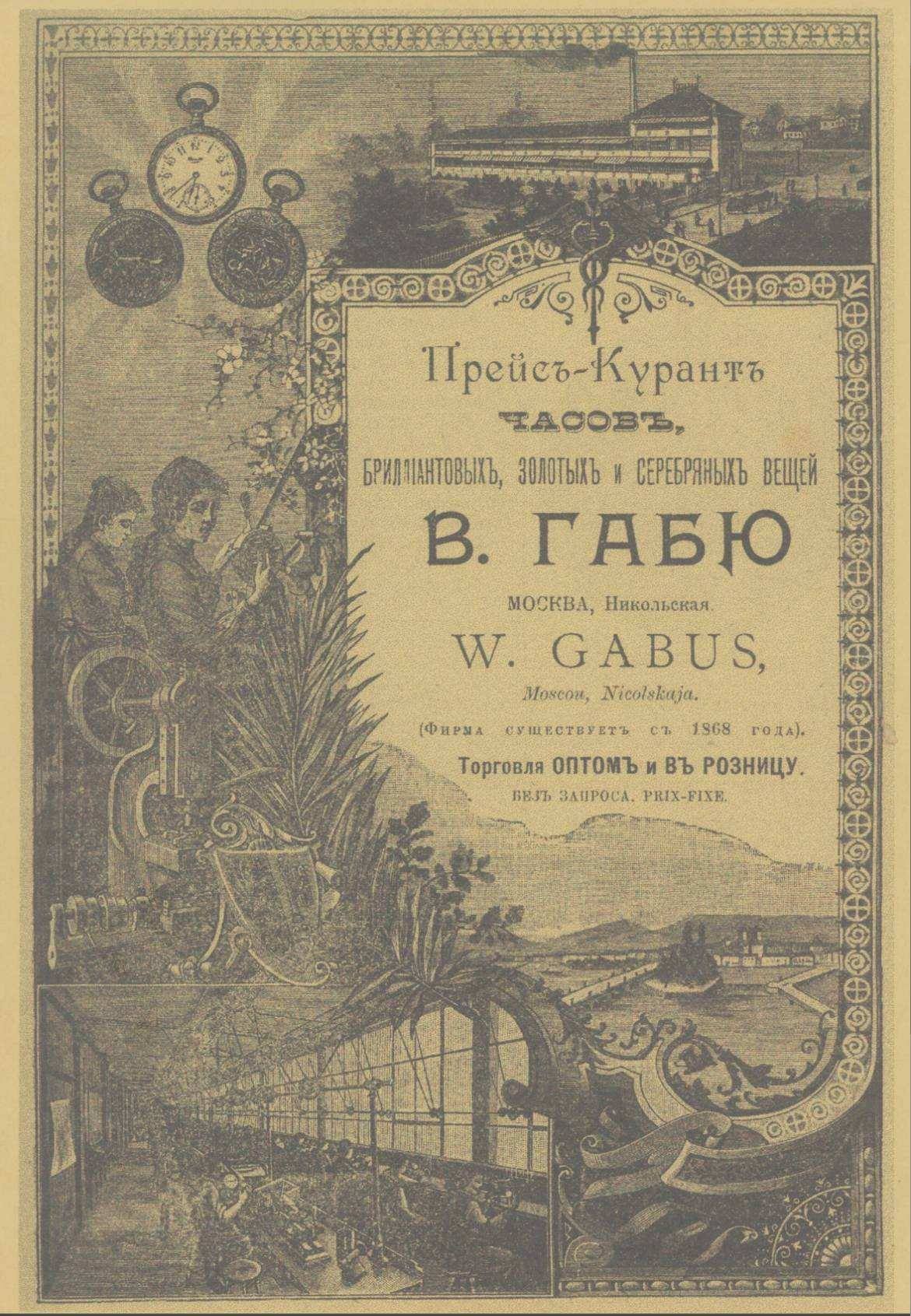
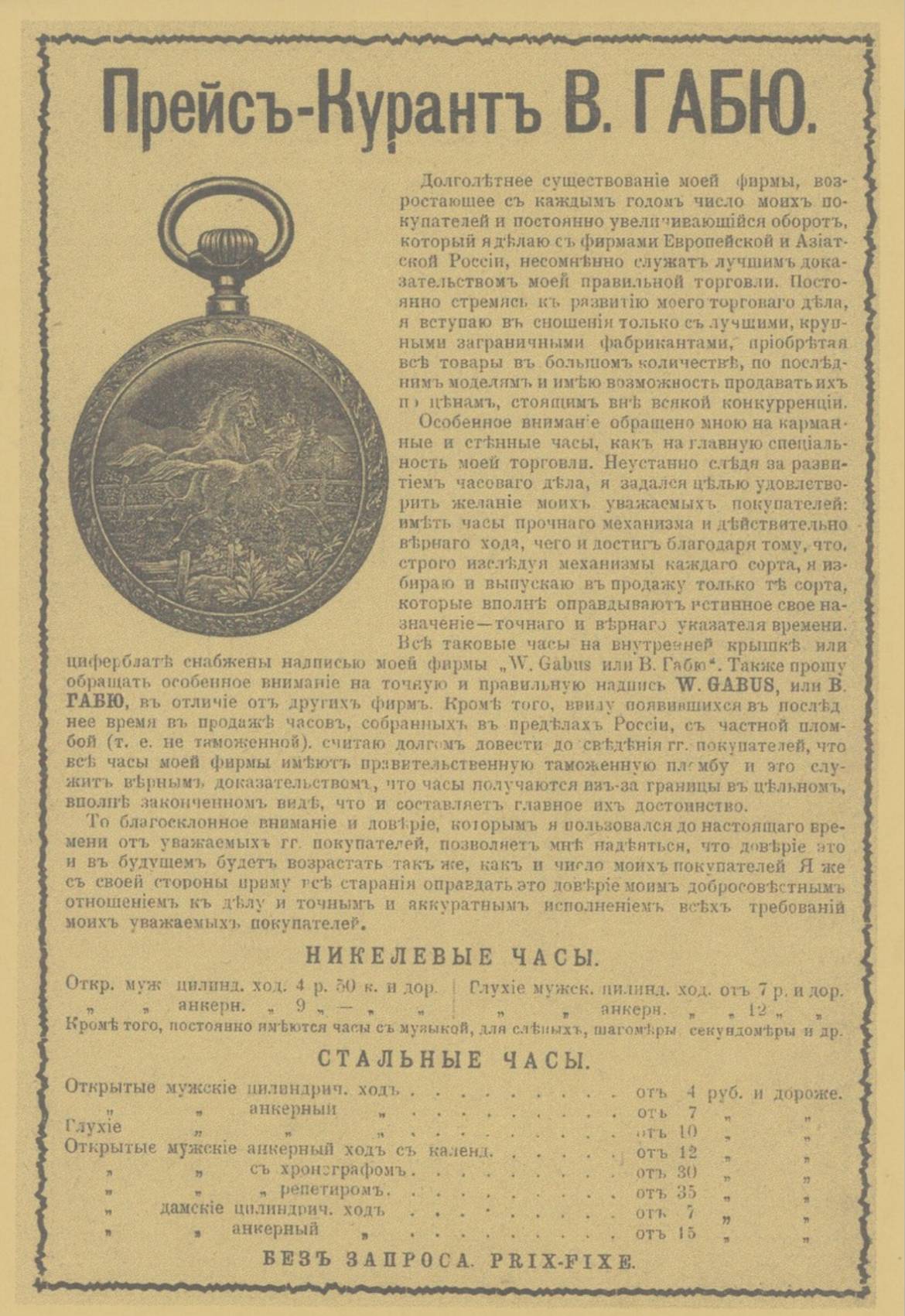
An illustrated period retail catalog survives — a “Прейсъ-Курантъ” (price list) issued under the name “В. ГАБЮ, Москва, Никольская.” The catalog carries no printed date; a date in the 1890s is consistent with what the pages do say, but no year appears on any page examined.
The preface states plainly that “the firm exists since 1868,” and asks customers to pay particular attention to the exact and correct inscription “W. GABUS” or “В. ГАБЮ,” expressly “in distinction from other firms” — a period retailer addressing name confusion directly in its own promotional material. A separate passage warns against watches assembled within Russia bearing a private rather than government customs seal, which William offers as proof his own stock arrived complete from abroad.
Retailer-issued catalogs of this kind rarely survive intact; this copy stands as one of the only primary commercial documents connected to the house.
Retailer, Workshop, Importer
W. Gabus was not a manufacturer — nothing in the surviving record points to production from raw material. The firm's own price list describes a “мастерская,” a workshop for finishing, repair, and custom commissions, not full manufacture.
From at least the 1890s the house carried Patek Philippe watches alongside its own stock; the surviving catalog's gold-watches price list names Patek by title but does not describe an exclusive agency relationship.
Two Longines watches signed by the Moscow house survive. One is an exhibition-type minute-repeating chronograph made for the Russian market, its case cast and chased with a bust of Admiral Fyodor Ushakov and its cuvette signed W. Gabus; Antiquorum records the Longines Museum confirming its sale to Schwob, Longines’ Russian agent, in 1911. The other is an ordinary gunmetal pocket watch with an enamel dial signed В. ГАБЮ; a collector report citing Longines’ registers records its sale to Schwob on 3 August 1912.
Longines archive extracts confirm that, for the Russian market, parts other than the movement were produced by Schwob under licence. A retailer’s name on a Russian-market Longines is therefore not unexpected, but neither watch by itself proves that W. Gabus manufactured the watch or held an exclusive Longines agency. Longines also appears on the №141 register, cased by Gabus Frères at Le Locle, a generation later — a separate Longines relationship, with no evidence linking the two dealings.
The Gabus name also appears on other houses in Le Locle — Gabus Frères and Gabus-Guinand among them, both related by family rather than by any documented commercial connection.
W. Gabus’s significance did not end with the Moscow trade.
Worb Castle & the Bern Zoo
In 1899, Louis William Gabus purchased Worb Castle, near Bern. His 1900 will left 150,000 francs to found Bern's zoo, specifically naming the Dählhölzli site — a bequest that became the Tierpark Dählhölzli's founding fund, still operating today.
Jean Gabus & the Bukhara Story
Nikolai Varentsov, a Moscow textile magnate, once mentioned to a friend that he couldn't find a fitting gift for the Emir of Bukhara, ruler of the Central Asian khanate. The friend — a man he knew as "Jean Gabus" — showed him a cracked antique watch-box; two days later, it came back fully restored, a turnaround that points to someone working at the Moscow house itself rather than visiting from abroad. Georges-John Gabus, Louis William's paternal half-brother, has been proposed as this "Jean Gabus" — but he was based in Les Brenets, Switzerland, running Gabus-Guinand, which sits uneasily with a personal two-day repair job in Moscow. No document confirms the identification, and the friend may simply have been someone working day-to-day at the house — an employee, or possibly Louis William himself under an informal name.
Beyond Watches
The firm's catalog lists trade across several categories beyond watches alone:
- Table & Carriage Clocks
- Wall Clocks
- Watches
- Gold Jewelry
- Silverware
- Optical Goods
Afterward
The W. Gabus name is currently used by a separately operated commercial watch brand, marketed under a “Swiss Made / Russian Soul” campaign. This archive has no affiliation with, and does not endorse or verify, any current commercial use of the Gabus name. Its claims are treated here as marketing, distinct from the documented history of the original firm above.
Open Questions
- The Bukhara “Jean Gabus” identification with Georges-John rests on circumstantial and genealogical evidence, not direct documentary confirmation.
- Whether the surviving catalog's Patek Philippe mention reflects a genuine supply relationship or simply retail stock alongside other brands remains unclear — the catalog names Patek but doesn't describe the actual arrangement.
- No closure or confiscation record specific to the Moscow house has been located; what happened between the 1917 Revolution and the firm's disappearance from the record is not documented in detail.
- Whether Hélène Gabus directed the house after William’s death is not settled. Russian-language sources describe a continuation under Hélène (Елена Францевна) Gabus, described as his widow, while a compiled CEJARE tableau records a divorce from Hélène Plaut in 1890 and a remarriage in March 1900. The tableau is not a civil register, and who directed the house after 1901 remains unresolved.
Cross-References
Georges-John Gabus, Louis William's paternal half-brother, is documented on the Gabus-Guinand page. Their first cousin, Georges Gabus, founded Gabus Frères — see the The Family page for the full family connection.
Sources
Sources: the period W. Gabus price list and N. A. Varentsov's memoir — primary. CEJARE, fonds Gabus Frères — the compiled genealogical tableaus only, not a W. Gabus corporate archive. Watch-Wiki (portrait photograph). Full sources